
What to Do When Your AC Freezes Up in the Texas Heat
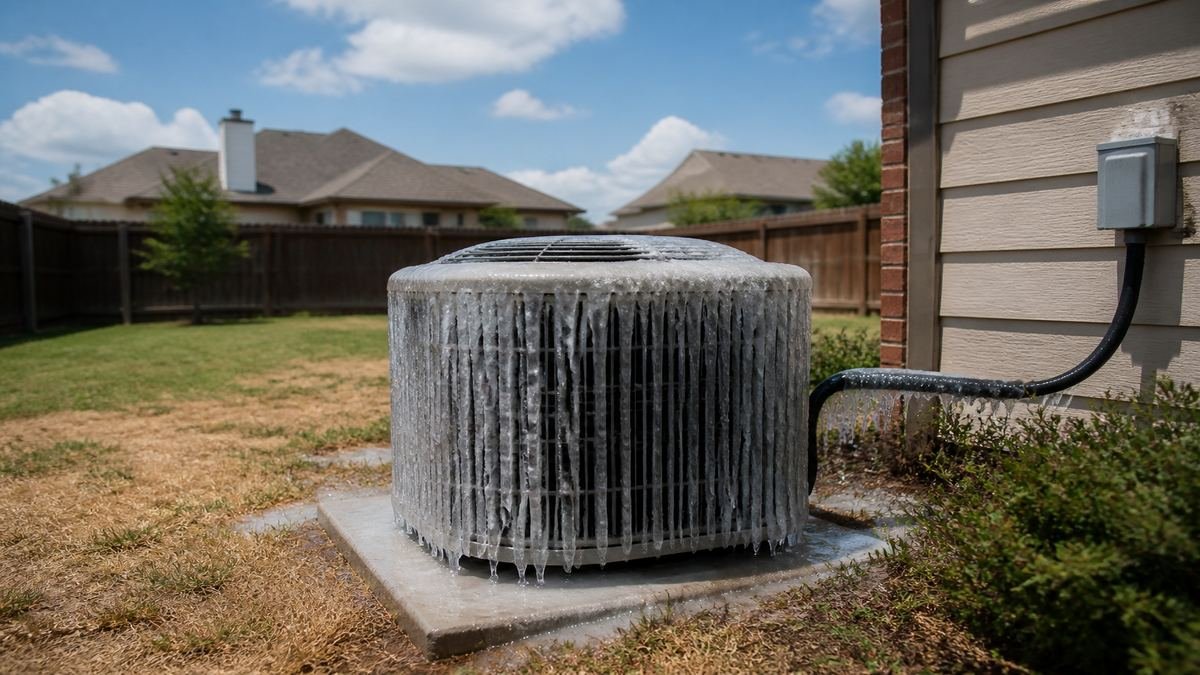
Why Is My AC Frozen in the Summer?
It sounds counterintuitive, but an air conditioner freezing over in the middle of a hot Texas summer is a very common problem. It is usually caused by restricted airflow or low refrigerant levels. When warm air can't flow over the evaporator coil, the condensation on the coil drops below freezing and turns into a solid block of ice.
Step 1: Turn It Off IMMEDIATELY
If you see ice on the indoor coil or the outdoor refrigerant lines, turn your thermostat from "Cool" to "Off" immediately. Leaving the AC running while it is frozen will put massive strain on the compressor. The compressor is the heart of your system, and replacing it can cost upwards of $2,000 to $3,000. Do not risk it.
Step 2: Turn the Fan to "On"
Turn the thermostat fan setting from "Auto" to "On". This will blow warm indoor air over the frozen coil to help it thaw out faster. Depending on the size of the ice block, this can take anywhere from 3 to 24 hours.
Step 3: Check Your Air Filter
A completely clogged air filter is the #1 cause of restricted airflow and frozen coils. If your filter looks like a fuzzy gray blanket, replace it immediately. Sometimes, this is the only fix needed.
Step 4: Call a Professional HVAC Technician
If you replace the filter and the system freezes up again, you likely have a refrigerant leak or a failing blower motor. Freon (refrigerant) leaks must be identified and sealed by a licensed professional. Attempting to add refrigerant yourself is illegal without EPA certification and highly dangerous. If you are in the DFW area, contact an emergency HVAC repair technician in Dallas or Fort Worth immediately to prevent permanent system failure.
Frequently Asked Questions
A: Absolutely not. The evaporator coils are made of thin copper or aluminum. One slip with a screwdriver will puncture the coil, releasing all the refrigerant and ruining the unit permanently.
Common ac & heating (hvac) problems in Texas homes
If you're reading this you probably ran into one of the situations below — these five buckets cover roughly 70–80% of the ac & heating (hvac) calls dispatched across Houston, Dallas, Austin, and San Antonio each week. Each item includes the actual fix and honest cost range, not marketing fluff.
No cool air from vents, outdoor unit is silent
Almost always electrical: failed capacitor, tripped high-pressure switch, or dead contactor. Diagnostic in 20-30 minutes. Capacitor swap $180-380 total; contactor $200-400.
No cool air, outdoor unit runs, indoor blower runs
Refrigerant-side issue — either low charge from a slow leak or a stuck TXV/metering device. Leak search plus recharge $400-900; TXV replacement $700-1400.
System cools, then trips off after 15-30 minutes
Overheating condenser, dirty evaporator, or low refrigerant tripping the freeze-stat. Coil cleaning $250-500; deep chemical clean $450-800.
Water dripping from ceiling near the indoor unit
Condensate drain line is clogged. Emergency shutoff, drain clear, and pan check runs $150-350. Left untreated causes drywall damage that costs 10x more.
Furnace ignites, then shuts off after seconds
Classic flame sensor issue in gas furnaces — the sensor is coated in oxide and can't confirm flame. Sensor clean is $180-280, replacement $250-400.
Honest ac & heating (hvac) pricing in Texas (2024–2025)
Ranges below are collected from independent, licensed Texas contractors — not a franchise call center. Every dispatched job gets a written estimate before work starts, so you always know the number before you approve.
| Scope | Typical range |
|---|---|
| Diagnostic / service call | $85 – $150 |
| Capacitor replacement (parts + labor) | $180 – $380 |
| Blower motor replacement | $400 – $900 |
| Refrigerant recharge (R-410A per lb) | $80 – $150 per lb (2–5 lb typical) |
| Full condenser + coil replacement (3-ton) | $5,000 – $8,500 |
| Full system (16 SEER2 heat pump, 3-ton) | $8,500 – $13,500 installed |
Prices exclude sales tax. After-hours (9pm–7am) and weekend calls typically add $25–75 depending on trade.
What to expect when the tech arrives
Every dispatched contractor follows the same clean process regardless of which Texas metro you're in. This is what a normal on-site visit looks like:
- Tech arrives with gauges, multimeter, refrigerant scale, common parts.
- Walks the outdoor unit and indoor air handler, reads static pressure and temperature split.
- Runs sequence-of-operation test to isolate electrical vs refrigerant vs airflow.
- Writes an estimate with parts, labor, and warranty terms.
- Executes repair, retests, and confirms proper delta-T and refrigerant pressures.
Seasonal notes for Texas ac & heating (hvac)
AC service calls spike in June-August (heat) and January-February (freeze). Book maintenance in April (AC) or October (heat) to avoid peak-season pricing and long wait times. Do NOT wait for a July no-cool call at 2x the normal rate.
Warranty & materials
Manufacturer warranties: 5-10 years on parts (Carrier, Trane, Lennox, Rheem, Goodman). Compressor: often 10 years on registered systems. Labor warranty from the contractor is typically 1-2 years. Registration MUST happen within 60-90 days of install — do it.
Frequently asked
Why isn't my AC cooling in your Texas city?
The most common causes we see: (1) a failed capacitor — the small can inside your outdoor unit that starts the compressor; (2) low refrigerant from a slow leak, usually at the evaporator coil or line-set joints; (3) a dirty condenser coil restricting heat rejection; (4) a frozen indoor coil from restricted airflow (clogged filter or blower issue). A diagnostic visit isolates the cause in 20–40 minutes.
How much does AC repair usually cost in your Texas city?
Simple part swaps (capacitor, contactor, thermostat) run $180–450 all-in. Refrigerant recharges run $250–700 depending on leak size. Blower motors, boards, and compressor issues are $500–2000. Anything above 40% of new-system cost we recommend replacement rather than repair.
Should I repair or replace an old AC unit?
General rule: if the unit is 12+ years old and the repair estimate exceeds 40% of a new system, replacement usually saves money over a 5-year window because newer SEER2 units use 30–45% less electricity. If under 8 years old, repair. In between it depends on refrigerant type (R-22 systems are no longer serviceable with new refrigerant) and warranty status.
What size AC unit does my house need?
Rough rule for Texas: 400–600 sqft per ton. A 2000 sqft single-story typically needs 3.5–4 ton. But orientation, insulation, ceiling height, and window area matter a lot — an oversized unit short-cycles and doesn't dehumidify. A proper Manual J load calculation is worth the $150–300 it costs before spending five figures on a new system.
Where Texaserv dispatches ac & heating (hvac) in Texas
Every job routes to a licensed contractor already working in the metro. Click through for the local pricing, response bands, and licensed contractor details:
